
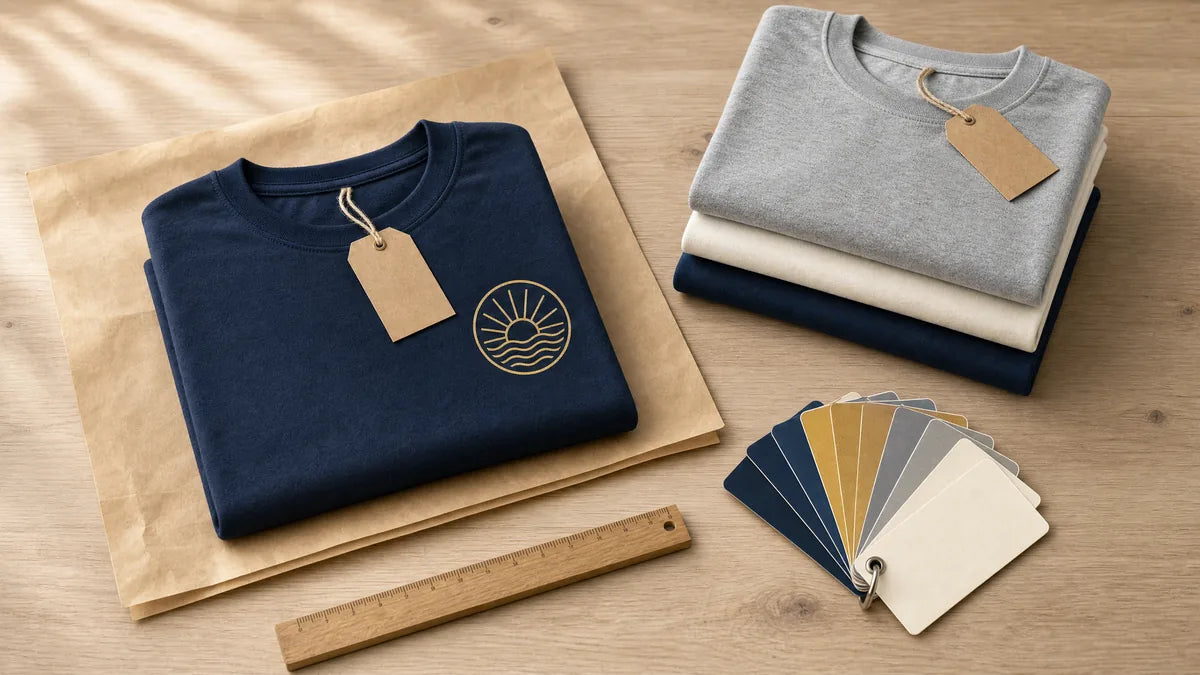
Where online t-shirt printing wins, and where it quietly costs you: proofs, blank substitutions, sizing, reorders, and what happens when an order goes wrong.
Custom Apparel • Buyer's Guide
Serving DeLand, Florida; Volusia County; Seminole County; Orange City; Deltona; DeBary; Daytona Beach; Sanford; Lake Mary; and surrounding Central Florida communities
The local print shop vs online printing decision is not about which one wins in general. It is about which one protects you when a real apparel order has to be right the first time. Online printing is genuinely good at some things and quietly weak at others, and the weak parts tend to show up after the box is already on your desk.
Key Takeaways
- Online printing wins on one-off shirts, novelty runs, and print-on-demand where nobody needs a proof or a fitting.
- A physical proof, a sample to try on, and in-person problem solving are where local shops save you money.
- Always compare the full delivered total, not the advertised unit price.
- Ask any vendor whether they substitute blanks, keep your art on file, and how they fix a wrong print.
What Online Printing Actually Means
Online printing usually means a large website where you upload a file, pick a garment from a dropdown, place your art on a digital preview, and check out. Production happens in a warehouse you never see, and the order ships to you in a box. There is no counter, no phone number that reaches the person running the press, and no chance to look at a printed shirt before the full run goes out.
That model is efficient and it is cheap to scale. The trade is that every step which normally involves a conversation gets replaced by a form field. For simple orders that is fine. For staff uniforms, team jerseys, or a bulk order tied to an event date, the missing conversation is where the risk lives.
Where Online Printing Genuinely Wins
It would be dishonest to pretend a local shop beats online printing at everything. It does not. There are orders where online is clearly the smarter buy, and a good local printer will tell you so.
- A single shirt for one person, or a tiny novelty run.
- Print-on-demand storefronts where you never want to hold inventory.
- Simple one-color art on a common blank with a flexible date.
- Orders where nobody needs to try a size on before it ships.
- Buyers in areas with no nearby decorator at all.
If that describes your order, an online site is often the right call and you can stop reading. The rest of this guide is for the orders where a mistake costs real money, real time, or a missed deadline.
Proofing: Seeing the Print Before the Whole Run Goes Out
This is the biggest hidden gap. An online site shows you a digital mockup, which is a rendering of your artwork floated over a photo of a shirt. It is not a proof. It cannot show you how a gold ink actually reads on a heather grey blank, how much a light ink shifts when it lands on a dark garment, or whether a thin serif font holds at the size you picked.

A local shop can print a single test, put it in your hand, and change the ink or the size before the full run. You can review a printer's past work and print samples to see how colors sit on real fabric, then confirm your own proof in person. The gap between a screen mockup and a physical proof is where most surprise reprints come from.
"A digital mockup tells you what your art looks like. A physical proof tells you what your order will look like. Those are not the same thing."
Blank Selection and Substitutions
Large online sites carry hundreds of styles and substitute freely when one is out of stock. The substitute is usually a different weight, sometimes a different fit, and occasionally a different shade of the same color name. Two orders of the "same" shirt placed six months apart can come back visibly different, which is a problem when you are adding a few uniforms to an existing set.

Before you commit, learn the differences between styles in a guide to blank apparel brands, then ask any vendor, online or local, whether they will substitute without asking and what happens if the substitute does not match. If a listing advertises garments as American made, remember that such claims are governed by the FTC's Made in USA standard, so it is fair to ask a vendor to back up the label.
Ask this early: "What exact blank are you printing, and will you swap it without telling me if it is out of stock?"
Sizing, Fit, and Trying a Sample On
Size charts measure the garment, not the person, and they vary by brand. Unisex sizing runs different from a ladies cut, and youth sizing overlaps adult small. A number on a chart does not tell you how a shirt sits on a real body.
A local shop can hand you a sample to try on before the order is placed. Online, you find that out after the box arrives. For a staff order, a team, or a church group, fit matters more than almost anything else, because you cannot cheaply reorder one shirt in a different size once the run is done.
Get a real proof before the whole run prints
Send us the blank you have in mind, the headcount by size, and the date the shirts need to be in hands. Include your print ready artwork at full size in vector format and we will show you exactly how it will read on the garment before anything goes on press.
Start Your Order →For any order where people have to wear the shirt every day, trying one sample on before you buy prevents the single most expensive apparel mistake: sizes that do not fit the group.
Turnaround and What Happens When the Date Moves
Online quotes advertise production time, not delivery time, and the two are not the same. A three day production window plus ground shipping is not a three day order. When you are counting backward from an event in Deltona or a season opener in Sanford, that difference decides whether shirts arrive in time.
A local shop can often stage a partial delivery so the people who need shirts first actually get them first. And when a date moves up, you can call and explain it to a person. An online portal has no field for "our event got moved and we need half of these sooner."
Reorders and Keeping Artwork on File
Reorders are where relationships pay off. Ask whether the shop keeps your artwork, your screens or transfers, your ink colors, and your specific blank on file, and whether a reorder runs at the same setup cost. Some online systems store nothing and treat every order as brand new, which means new setup and a fresh chance for the print to look slightly different.
This is also why finished files matter. Qwik Tees prints from print-ready artwork such as vector or high-resolution logo files, and having clean files on record keeps your second run matching your first. Consistent art plus a consistent blank is what makes uniforms actually look like a set over time.
Fixing a Problem After the Order Arrives
This is the real difference between the two options. When six shirts come back with a print that is off center or an ink that cracked in the first wash, a local shop looks at the shirt, agrees or disagrees in person, and reprints. The whole exchange can happen in one visit.

An online claim usually means photographs, a support ticket, a review window, and a shipping label. The dollar value of the reprint is often small. The time cost of proving the problem and waiting for a resolution is not, especially when the shirts were needed for a date that has already passed.
Cost: Compare the Whole Order, Not the Unit Price
Unit price is the number vendors lead with because it looks good in isolation. What actually leaves your account is the delivered total. Add it all up before you decide.
- Setup fees and art fees
- Per-color charges on multi-color designs
- Size upcharges for 2XL and larger
- Rush fees
- Shipping both ways if something has to go back
- The cost of a reorder if sizes come back wrong
A low unit price with a high setup fee loses on a small run and wins on a large one. That is why a bulk order printed with screen printing can come out ahead per shirt while a short run does not. Apparel is generally an ordinary business cost, and the IRS's guide to business expense resources, available through IRS business expense resources, is a starting point for how those costs are treated, so keep your full invoice rather than just the per-shirt figure. Local is not automatically cheaper, and any printer who claims it always is has not done your math.
When Online Printing Is the Right Call
To be fair and clear: if you need one shirt, a small novelty batch, or a print-on-demand store where inventory would be a burden, online printing is the better tool. The same is true for simple one-color art on a common blank when the date is flexible and nobody needs to try a size on.
The honest way to choose is to match the vendor to the job, the same way you would match the decoration to the design in a breakdown of how to choose a print method. When accuracy, fit, deadlines, and easy fixes matter, a nearby shop earns its keep. When they do not, online is fine and there is no shame in using it.
Questions to Ask Any Printer Before You Order
Copy this short list into an email and send it to any vendor you are considering, local or online. The answers tell you almost everything about how an order will go.
- What exact blank are you using, and will you substitute it without asking me?
- Can I see a physical proof, not just a digital mockup?
- What is the delivered date, not the production date?
- What are the setup and art fees, and any size upcharges?
- Do you keep my artwork on file for reorders at the same setup cost?
- What happens, step by step, if the print comes out wrong?
If you are printing for a business, school, team, church, or nonprofit anywhere across Volusia County or Seminole County, it costs nothing to talk to a real printer about your order before you commit. Local business owners can also verify permits and county services through the Volusia County government site while they line up branded apparel. Qwik Tees Printing & Embroidery in DeLand is happy to walk through a proof, a sample size, and a full delivered quote so the whole run is right the first time.
Frequently Asked Questions
Is online printing always cheaper than a local print shop?
Not always. A low unit price can hide setup fees, art fees, size upcharges, rush fees, and shipping both ways. Compare the full delivered total for your exact quantity, not the advertised per-shirt price.
What is the difference between a digital mockup and a real proof?
A digital mockup is a rendering of your artwork floated over a photo of a shirt. A physical proof is an actual printed sample you can hold, which shows how the ink reads on that specific garment color and fabric before the full run is produced.
Where can I get custom apparel near DeLand and Volusia County?
Qwik Tees Printing & Embroidery is based in DeLand and serves DeLand, Orange City, Deltona, DeBary, Daytona Beach, Sanford, Lake Mary, and the surrounding Volusia County and Seminole County areas. Local ordering lets you see a proof, try a sample size, and handle any issue in person.
Will a printer substitute my shirt if the blank is out of stock?
Some vendors substitute freely without asking, and the replacement may differ in weight, fit, or shade. Always ask any printer, local or online, whether they substitute automatically and what happens if the substitute does not match your original.
Do I need finished artwork to place an order?
Yes. Qwik Tees prints from finished, print-ready artwork such as vector files or high-resolution logo files. Having clean files ready keeps proofing accurate and helps your reorder match the first run.
Get a real proof before the whole run prints
Send us the blank you have in mind, the headcount by size, and the date the shirts need to be in hands. Include your print ready artwork at full size in vector format and we will show you exactly how it will read on the garment before anything goes on press.
Start Your OrderNo commitment required · Free consultation


