
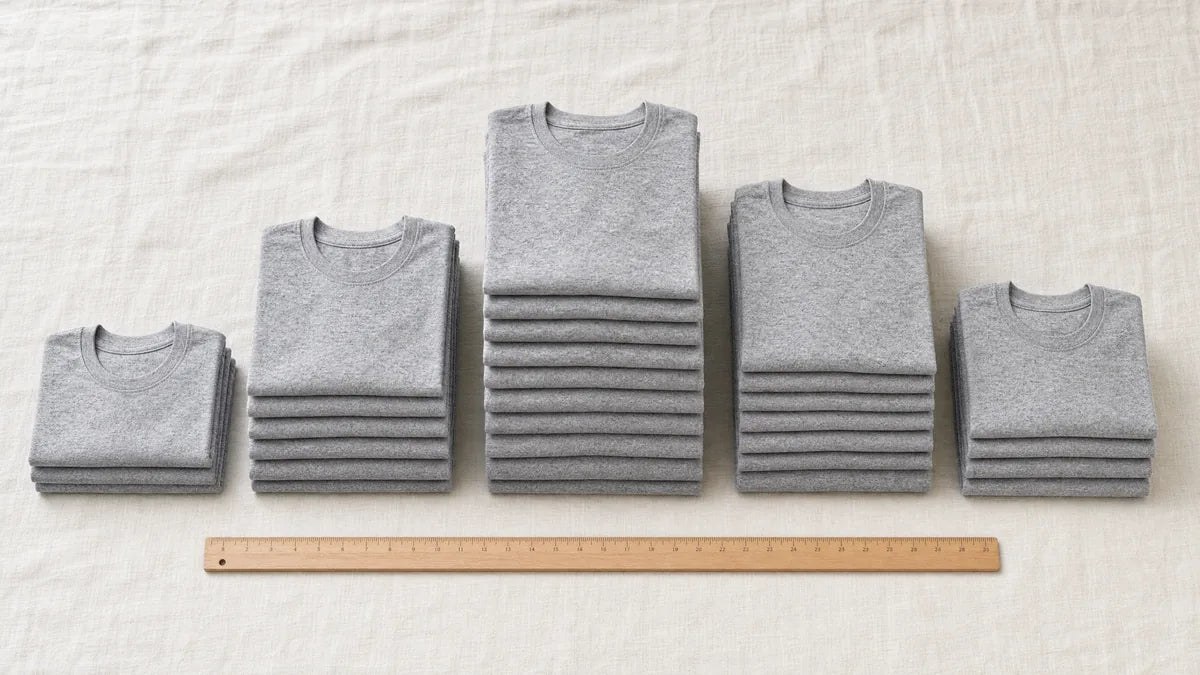
How many small, medium, large, and 2XL shirts to order for a group. A baseline size curve, how to adjust it, and how many extras to add before you print.
Apparel Guides • Group Ordering
Serving DeLand, Florida; Volusia County; Seminole County; Orange City; Deltona; DeBary; Daytona Beach; Sanford; Lake Mary; and surrounding Central Florida communities
You already picked the shirt. Now you are staring at a blank order form wondering how many smalls, mediums, and XLs to buy. A smart t-shirt order size breakdown is not a guess, it is a forecast, and there is a repeatable way to make that forecast far better than splitting the numbers evenly.
Key Takeaways
- Most adult groups center on L and XL, not M, so weight your order there.
- A weighted size curve beats ordering an even number of every size every time.
- Collect sizes with one short form and a deadline, then set a default for non-responders.
- Keep unisex, ladies cut, youth, and extended sizes as separate lines.
- Add 5 to 10 percent extras up front because reorders are more expensive later.
Why the Size Breakdown Decides Whether the Order Works
The design gets the attention, but the size breakdown decides whether people actually wear the shirt. Order the wrong quantities and you end up with a box of smalls nobody claimed and three frustrated crew members who never got an XL. The single most common mistake is ordering a flat, even number of every size, because it treats a group like a symmetrical bell when real groups almost never are.
A good t-shirt order size breakdown starts from a realistic curve and then adjusts to the group in front of you. Think of it as a forecast you can defend with numbers, not a shrug and an even split. Get it right and almost everyone gets a shirt that fits on day one.
A team member who does not get a shirt in their size remembers that far longer than anyone remembers the shirt itself.
Start With a Baseline Curve, Then Adjust It
For a general adult unisex US audience with no other information, a common starting distribution looks like the table below. Treat it as a launch point, not a law. The center of the curve is L and XL for most adult groups, which is exactly where an even split falls short.
| Size | Baseline share |
|---|---|
| S | 5 to 10% |
| M | 20% |
| L | 28% |
| XL | 25% |
| 2XL | 12% |
| 3XL and up | 5 to 8% |
From there, push the curve in the direction of your group. Nudge it larger for construction, warehouse, manufacturing, trades, and most male-dominated crews. Pull it smaller for a majority-female group, a running or fitness event, or a ladies cut style. Widen it on both ends when you are printing custom t-shirts for a general public giveaway where you have no roster at all.
Quick rule: If you are unsure which way to adjust, move mass toward XL before you add smalls. Extra XL is easier to place than extra S.
Collecting Sizes Without Chasing People for Two Weeks
A short form with one question and a deadline beats a group chat every time. Ask people for their usual tee size, and include the exact fit note in the request, for example: unisex sizing, runs standard, order your usual tee size. Most people answer with the number on their favorite shirt rather than a tape-measure reading, so tell them which shirt to think of.
Do not chase non-responders. Give them a default instead. Assign L or XL depending on the group and say so in the request, so anyone who cares about their size will speak up. Then close the form before you order, not after. If you plan group projects often, free planning templates from SCORE, the small business mentoring nonprofit, can help you build a simple, repeatable intake process.
- One field: your usual adult tee size.
- One fit note so people answer consistently.
- One deadline, clearly stated.
- One default for anyone who does not reply.
Adult Unisex and Ladies Cut Are Two Different Curves
Ladies cut is a different garment, not a smaller version of the same shirt. It runs narrower through the body and shorter in length, so many people who wear a unisex L wear a ladies XL. That gap alone will wreck an order if you treat the two as one pool.

Keep ladies cut as its own count with its own curve, and never split a single size total across two cuts. If eight people asked for a ladies medium, order eight ladies mediums as their own line item. Blending the numbers to make the math look tidy is how a shirt ends up fitting nobody the way they expected.
"Ladies cut and unisex are two different curves. Count them separately or you will short one and overshoot the other."
Extended Sizes and Why They Need Their Own Line
Sizes 2XL and up frequently carry an upcharge and sometimes come from a different lot or a slightly different fabric. Order them as a named line on your breakdown, confirm they are available in the color you picked before you commit, and never quietly leave them out to save a little money.

This is where an even split fails in the other direction. A flat count usually under-orders 2XL and 3XL, which are exactly the sizes hardest to add later. If your group skews toward the trades, expect the top of the curve to carry real weight and plan for it up front.
Youth Sizes Inside a Mixed Group Order
Youth L is not adult S. If your group includes both adults and kids, run two completely separate counts and label them clearly on the order so nothing gets merged. This comes up constantly for youth sports teams, church groups, and family reunions across Volusia County and Seminole County.
Send us your size counts and we will check them
Give us the headcount by size, whether you need unisex or ladies cut or both, and the exact blank you want. Include your print ready artwork at full size in vector format and we will flag anything in the breakdown that looks off before the order goes to press.
Start Your Order →Rather than eyeballing children's measurements, use a proper reference. Our youth apparel sizing guide breaks down youth sizing so you can collect kid sizes with the same confidence you use for adults, then keep those numbers on their own line.
Label everything: Write "YOUTH" and "ADULT" next to every size count. A clear label prevents a youth medium and an adult medium from getting added together.
How Many Extras to Add, and Which Sizes
On a roster order, add roughly 5 to 10 percent overage, weighted toward the middle sizes. That is where a replacement is most likely to be needed and where an extra is easiest to use later, whether for a new hire or a shirt that got ruined on week one. Middle sizes rarely sit in a box for long.
On a giveaway, shift the extras toward L and XL, since that is where public demand concentrates. Either way, extras are cheapest to add before the run and most expensive to add after. Building the overage into the first order is almost always smarter than a small second order.
Sizing an Order for Giveaways and Events
When you have no roster, such as a booth handout, a 5K, or a community event, lean on a public-handout split that skews to the middle. A practical starting point is something close to S 10 percent, M 25 percent, L 30 percent, XL 25 percent, and 2XL 10 percent.
Leftovers from a giveaway hold real value if the design is not dated, so avoid printing a specific year or a one-time event date on a shirt you want to keep handing out. Print an evergreen logo and every unused shirt becomes next season's giveaway instead of landfill.
Fabric and Fit Change the Curve
The blank you choose can quietly move the whole curve. A 100 percent cotton tee shrinks in length after washing, while a tri-blend or a fashion fit runs noticeably slimmer than a standard unisex tee. If you switch blanks after collecting sizes, the numbers you gathered may no longer describe the shirt people will actually receive.
Shrinkage and durability are not guesswork. Fabrics are measured against published test methods from ASTM International, the standards development organization, which is why a cotton tee and a poly blend behave differently in the wash. Care instructions on the label, required under the FTC's Care Labeling Rule, tell wearers how to keep that fit consistent over time.
Before you lock quantities, confirm the fit description of the exact blank you are ordering. If you are still choosing a garment, our guide to blank apparel brands can help you match fabric and fit to your group so the curve you collected still holds.
What to Do When You Guess Wrong
Even a careful forecast can miss. When it does, you have a few honest options: a small reorder at a higher per-piece cost, swapping shirts within the group, holding leftovers for new hires or next season, or building a better roster for next time. None of these are disasters if you planned for a little slack.
Be clear-eyed about one thing: a reorder of a handful of shirts usually carries setup again, which is exactly why the extras line exists in the first place. If you want a second set of eyes before you commit, send us your size breakdown and we will sanity-check the numbers against the group you described.
A Worked Example: Ordering for Fifty People
Say you are ordering shirts for a fifty-person crew at a local trades company. Of those fifty, forty want unisex tees and ten want ladies cut. Because the group skews male and physical, you push the unisex curve larger, and you keep ladies cut on its own line. This is the same method we use when we build team and group uniforms for organizations around DeLand and Central Florida.

Start with the forty unisex shirts, pushed toward the top of the curve: S 2, M 6, L 10, XL 12, 2XL 6, 3XL 4. That adds up to 40. Next, the ten ladies cut shirts get their own smaller curve: S 2, M 3, L 3, XL 2, which adds up to 10.
Now add about 10 percent overage, weighted to the middle. That is 5 extra unisex shirts placed as M 2, L 2, XL 1. Fold those into the unisex line and the final counts look like this:
| Line | Sizes | Total |
|---|---|---|
| Unisex | S 2, M 8, L 12, XL 13, 2XL 6, 3XL 4 | 45 |
| Ladies cut | S 2, M 3, L 3, XL 2 | 10 |
| Grand total | 55 |
Fifty people, fifty-five shirts, with the overage sitting in the middle sizes where it is easiest to use. The arithmetic is visible, the extended sizes are named, and the two cuts never got mixed. That is a t-shirt order size breakdown you can actually defend.
Your Group Order Sizing Checklist
- Start from the baseline curve, then adjust larger or smaller for your group.
- Collect sizes with one short form, one fit note, one deadline, and one default.
- Keep unisex, ladies cut, youth, and extended sizes on separate labeled lines.
- Confirm 2XL and up are available in your color before you commit.
- Add 5 to 10 percent extras up front, weighted to the middle sizes.
- Verify the exact blank's fit before you lock final quantities.
Whether you are outfitting a crew in Deltona, a church group in Orange City, or an event team in Sanford, a weighted size curve gets shirts on people the first time. When you are ready to turn your headcount into a clean order, reach out to Qwik Tees Printing & Embroidery and we will help you finalize the breakdown.
Frequently Asked Questions
What is a good default size breakdown for an adult group with no roster?
A common starting curve is roughly S 5 to 10 percent, M 20 percent, L 28 percent, XL 25 percent, 2XL 12 percent, and 3XL and up 5 to 8 percent. The center of most adult groups sits at L and XL, so weight your order there rather than ordering an even number of every size.
Should I order the same number of each size to be safe?
No. Ordering a flat, even count of every size is the most common mistake because it leaves a stack of unwanted smalls and a shortage of L, XL, and 2XL. A weighted curve tied to your actual group is far more accurate.
How many extra shirts should I add to a group order?
Add roughly 5 to 10 percent overage on a roster order, weighted toward the middle sizes where replacements are most likely needed. On a public giveaway, weight your extras toward L and XL instead.
Do ladies cut and unisex shirts use the same size counts?
No. Ladies cut is a different garment that runs narrower and shorter, so many people who wear a unisex L wear a ladies XL. Keep ladies cut as its own separate count with its own curve, and never split one size total across two cuts.
Where can I get help with a group t-shirt order size breakdown near DeLand, Florida?
Qwik Tees Printing & Embroidery in DeLand helps businesses, schools, teams, and churches across Volusia County and Seminole County plan quantities per size before printing. Send your roster or headcount and we will help you build a size curve that fits your group.
Send us your size counts and we will check them
Give us the headcount by size, whether you need unisex or ladies cut or both, and the exact blank you want. Include your print ready artwork at full size in vector format and we will flag anything in the breakdown that looks off before the order goes to press.
Start Your OrderNo commitment required · Free consultation


