
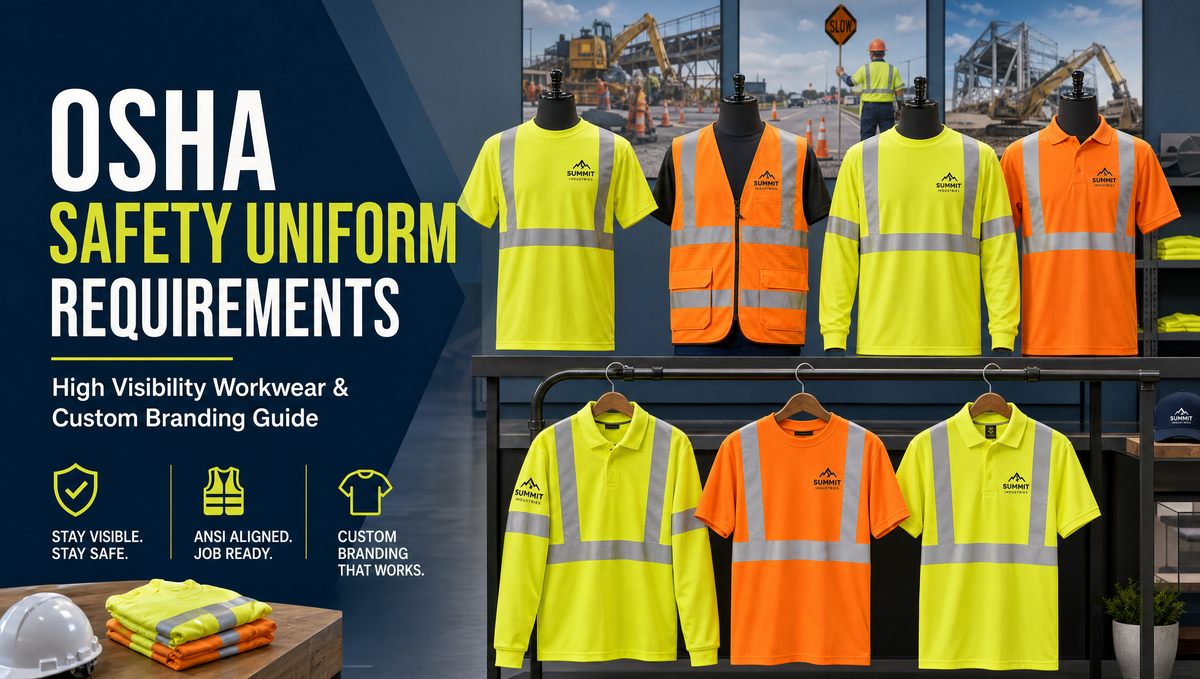
Understand OSHA safety uniform requirements, ANSI/ISEA 107 classes, high visibility workwear, and custom branding options for your Central Florida crew.
Workwear • Safety Uniforms
Serving DeLand, Florida; Volusia County; Seminole County; Orange City; Deltona; DeBary; Daytona Beach; Sanford; Lake Mary; and surrounding Central Florida communities and surrounding areas
Meeting OSHA safety uniform requirements is about more than looking professional. For construction crews, contractors, landscapers, and utility teams, the right high visibility workwear keeps people seen, safe, and identifiable on the job. This guide breaks down what employers should understand about safety apparel, ANSI/ISEA 107 standards, and adding custom branding without compromising visibility.
Key Takeaways
- OSHA does not require one uniform for every worker; requirements depend on jobsite hazard exposure.
- High visibility apparel is commonly expected near traffic, equipment, and low-light conditions.
- ANSI/ISEA 107 defines garment Types (O, R, P) and Classes (1, 2, 3) by risk level.
- Custom logos can be added to many safety garments if placement avoids reflective striping.
- Always confirm required garment class and specs before ordering compliance-critical apparel.
Why Safety Uniforms Matter for Working Crews
Safety uniforms serve several jobs at once. They help workers stay visible around moving vehicles and heavy equipment, they identify who belongs on a jobsite, and they project a professional image to clients and the public. For companies that send crews into work zones, warehouses, or roadside environments, well-chosen safety uniforms are a practical part of everyday operations. When your team looks organized and equipped, it builds trust with customers and signals that your business takes safety seriously.
There is also a compliance angle. Employers are generally responsible for assessing workplace hazards and providing appropriate protective apparel when conditions call for it. That means the shirt or vest your crew wears is not just a branding choice, it can be tied directly to how you keep workers safe on the job.
What Are OSHA Safety Uniform Requirements?
One of the most common misconceptions is that OSHA requires a single, universal uniform. In plain language, it does not. OSHA safety uniform requirements are driven by hazard exposure, not a one-size-fits-all rulebook. Employers are expected to evaluate the hazards workers face and provide suitable protective equipment or safety apparel when those hazards require it.
That is why a warehouse forklift operator, a roadside flagger, and an HVAC technician may all need different apparel. The right choice depends on the environment, the tasks involved, the level of traffic or equipment exposure, and any contract or site-specific rules that apply. Understanding that distinction is the first step toward outfitting your team correctly.
OSHA does not prescribe one uniform for every worker. The employer identifies the hazards, then selects apparel appropriate to those hazards and the work environment.
When High Visibility Safety Apparel Matters
High visibility apparel becomes important whenever workers need to be seen clearly, especially around traffic, machinery, or in low-light settings. If your crew operates in any of the situations below, hi-vis clothing is often required or strongly expected:

- Road work and highway maintenance
- Active construction zones
- Flagging and traffic control operations
- Excavation work near public traffic
- Parking lot and pavement work
- Utility and line crews
- Landscaping near roadways
- Warehouse or forklift environments
- Outdoor service crews working curbside
- Low-light, dusk, or poor-visibility conditions
If your team works in more than one of these settings, it may make sense to standardize on a higher visibility class so a single garment covers multiple scenarios. Reviewing where your crews actually spend their day is the easiest way to decide what level of visibility they need.
Understanding ANSI/ISEA 107 High Visibility Standards
When high visibility apparel is required, ANSI/ISEA 107 is the standard that usually applies. It sets performance requirements for how visible a garment is, based on background material, reflective striping, and design. The goal is simple: match the apparel to the worker's risk level and environment.
The standard uses garment types and performance classes to keep things organized. Here is the buyer-friendly version:
- Type O is generally for off-road use away from public traffic.
- Type R is generally for roadway and right-of-way use where traffic is present.
- Type P is generally for public safety and first responder use.
- Class 1, Class 2, and Class 3 indicate increasing amounts of visible material, with higher classes offering greater visibility for higher-risk environments.
"The higher the traffic speed and the lower the visibility, the higher the ANSI class you typically need."
You do not need to memorize every detail of the standard, but you should know which class and type your jobsite calls for before you order. If a contract or general contractor specifies a class, that requirement takes priority.
Quick tip: If you are unsure of the class you need, ask your general contractor or safety manager to confirm the required ANSI/ISEA 107 class in writing before ordering.
Common Types of Safety Uniforms and High Visibility Workwear
Safety apparel comes in far more styles than the classic orange vest. Depending on your climate, tasks, and comfort needs, your team might use any combination of the following:
Need Branded Safety Uniforms for Your Crew?
Qwik Tees can help your business choose high visibility workwear, safety shirts, reflective apparel, and branded work uniforms based on your team’s needs, artwork, quantity, and garment requirements.
Request a Safety Uniform Quote →- High visibility t-shirts for everyday crew wear
- Safety vests for layering over regular clothing
- Reflective work shirts with striping
- Hi-viz long sleeve shirts for sun and abrasion protection
- Safety polos for a cleaner, professional look
- High visibility hoodies for cooler mornings
- Construction and jobsite shirts built for durability
- Moisture-wicking safety shirts for hot Florida workdays
- Branded work shirts for supervisors and support staff
- Safety headwear when appropriate for the role
In Central Florida heat, breathable and moisture-wicking hi-vis shirts are especially popular with landscaping and construction crews around DeLand, Deltona, and Sanford. Choosing comfortable fabrics helps ensure workers actually keep their safety apparel on all day.
Branded Jobsite Apparel and Custom Logos
Adding your company identity to safety apparel is one of the smartest ways to build recognition while your crews are out working. Well-designed work uniforms turn your team into a visible, professional presence on every job. Businesses commonly add:

- Company logos and names
- Employee first names
- Business phone numbers
- Department or crew labels
- Service or specialty information
- Approved project or sponsor branding when appropriate
The key with high visibility garments is placement. Branding should be planned so it does not cover reflective striping, shrink the required background material, or interfere with the manufacturer's compliance labeling. A logo placed in the wrong spot can reduce a garment's effectiveness, so decoration on hi-vis apparel deserves a little extra planning compared to a standard t-shirt.
Choosing the Right Decoration Method
The best decoration method depends on your design, fabric, quantity, and how the garment will be used. For larger safety uniform orders with simple logos, company names, phone numbers, and crew shirts, screen printing is often the most cost-effective choice and holds up well to repeated washing and heavy use.
For full-color logos, smaller runs, detailed artwork, or certain performance and synthetic fabrics, DTF printing offers sharp, durable results without the setup costs of a large screen print order. It is a flexible option when your branding has gradients, multiple colors, or fine detail.
Embroidery is a great fit for polos, hats, jackets, and supervisor apparel where a raised, professional look matters. Qwik Tees offers embroidery services for exactly these applications. That said, embroidery is not always ideal for every hi-vis garment, since stitching in the wrong area can interfere with visibility zones or reflective striping. We can help you decide where embroidery makes sense and where a printed method is the safer call.
Artwork note: Qwik Tees prints from finished, print-ready files. Please provide vector or high-resolution logo artwork so your safety apparel comes out clean and professional.
Industries That Rely on Safety Uniforms
A wide range of businesses depend on branded safety apparel to protect and identify their teams. Across Volusia County, Seminole County, and the wider Central Florida area, we regularly help outfit:
- Construction companies and general contractors
- Landscapers and lawn care crews
- Road crews and traffic control teams
- Utility, electrical, and line crews
- HVAC, plumbing, and mechanical companies
- Warehouse and distribution teams
- Maintenance and facilities crews
- Event staff and outdoor service businesses
- Municipal and public-facing crews
Whether you run a small two-person operation in Orange City or manage a larger crew working across Daytona Beach and Lake Mary, the right safety uniform program keeps your team consistent and recognizable.
How to Source Safety Uniforms With Custom Branding
Ordering safety apparel goes more smoothly when you work through the details in order. Follow these steps to get garments that fit your work environment and your branding needs:
- Identify the work environment and the hazards your crew faces.
- Determine whether ANSI-rated apparel is required for your jobsite.
- Choose the garment type and visibility class that matches the risk.
- Select logo placement carefully to avoid reflective and visibility zones.
- Choose the right decoration method for your fabric and design.
- Confirm sizing and quantity for your full team.
- Request a proof before production so you can approve the layout.
- Keep records of garment specs if compliance documentation matters.
Working through these steps up front helps prevent costly reorders and ensures your apparel supports both your branding and your safety goals.
How Qwik Tees Can Help
Qwik Tees Printing & Embroidery helps local businesses choose branded safety apparel, work shirts, and high visibility uniforms that fit their team and their budget. We can walk you through garment options, recommend smart branding placement that respects reflective areas, and advise on whether screen printing, DTF, or embroidery is the better decoration method for your project.
To be clear and honest: we do not determine legal or OSHA compliance for your jobsite. That responsibility stays with you and your safety leadership. What we can do is help you source appropriate garment options and decorate them professionally once you know the class and type you need.
Safety Uniform Ordering Checklist
- Confirm the hazards and visibility needs for each role
- Verify any required ANSI/ISEA 107 class or type in writing
- Pick garment styles suited to Florida heat and daily use
- Plan logo placement away from reflective striping
- Match the decoration method to fabric, color count, and quantity
- Approve a proof and confirm sizing before production
Safety uniforms work best when they balance visibility, comfort, durability, branding, and jobsite requirements. When you are ready, reach out to Qwik Tees for a quote and share your work environment, quantity, garment type, and logo details so we can point you toward the right options. Explore our full range of custom apparel services to see everything we can decorate for your crew.
This guide is for general informational purposes only and should not be treated as legal or safety compliance advice. Requirements can vary by jobsite, role, hazard exposure, and governing standards. If ANSI-rated or OSHA-required apparel is needed, confirm the required garment class and specifications before ordering.
Frequently Asked Questions
What are OSHA safety uniform requirements?
OSHA does not mandate one uniform for every worker. Instead, employers must identify workplace hazards and provide appropriate protective apparel when conditions require it, which often includes high visibility clothing for workers exposed to traffic, equipment, or low-light environments.
Does OSHA require high visibility clothing?
High visibility apparel is commonly required or expected when workers are exposed to vehicle traffic, construction zones, or poor-visibility conditions. The specific requirement depends on the hazard, the role, and any governing standards or contract terms for the jobsite.
What is ANSI/ISEA 107?
ANSI/ISEA 107 is the major performance standard for high visibility safety apparel. It defines garment types (O, R, and P) and performance classes (1, 2, and 3) that match apparel to the worker's risk level and environment.
Can safety uniforms be customized with a company logo?
Yes. Many safety garments can be decorated with logos, names, and phone numbers. Branding should be placed carefully so it does not cover reflective striping, reduce visibility zones, or conflict with the manufacturer's compliance labeling.
Where can I get custom safety uniforms near DeLand and Volusia County?
Qwik Tees Printing & Embroidery in DeLand, Florida helps businesses throughout Volusia County, Seminole County, and Central Florida source branded work shirts and high visibility apparel with screen printing, DTF, or embroidery. Request a quote with your garment type, quantity, and logo details to get started.
Need Branded Safety Uniforms for Your Crew?
Qwik Tees can help your business choose high visibility workwear, safety shirts, reflective apparel, and branded work uniforms based on your team’s needs, artwork, quantity, and garment requirements.
Request a Safety Uniform QuoteNo commitment required · Free consultation


