
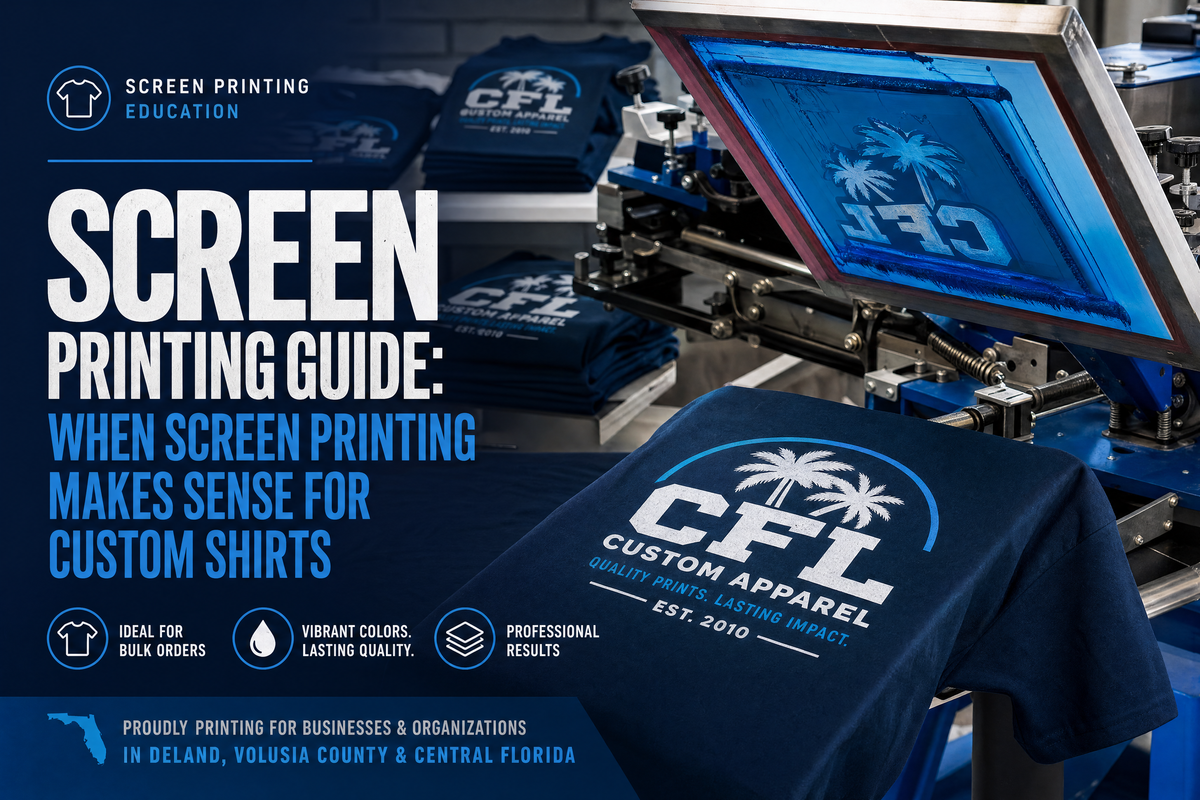
Learn when screen printing is the best choice for custom shirts. This guide covers bulk orders, design tips, and local options in DeLand and Central Florida.
Printing Methods • Educational Guide
Serving DeLand, Florida; Volusia County; Seminole County; Orange City; Deltona; Daytona Beach; Sanford; Lake Mary; Central Florida and surrounding areas
Screen printing remains one of the most popular and cost-effective methods for producing custom apparel, but it is not the right choice for every order. Understanding when screen printing for bulk custom shirts makes sense can save you money, improve your results, and help you get exactly what you need for your business, school, church, or organization.
What Is Screen Printing?
Screen printing, also called silk screening, is a traditional printing method that uses mesh screens to transfer ink onto fabric. Each color in your design requires a separate screen, and ink is pushed through the mesh onto the garment using a squeegee. The result is a vibrant, durable print that bonds directly with the fabric fibers.
This method has been used for decades because it produces consistent, high-quality results on large quantities of garments. Local businesses throughout DeLand, Orange City, and Deltona rely on screen printing for their staff uniforms, promotional shirts, and branded apparel because of its proven durability and professional appearance.
How Screen Printing Works in Simple Terms
The screen printing process begins with creating a stencil, or screen, for each color in your design. If your logo has two colors, two separate screens are created. Your artwork is transferred onto a mesh screen coated with a light-sensitive emulsion, then exposed to light to create the stencil pattern.
Once the screens are prepared, the printing process is straightforward. A shirt is placed on a flat printing surface called a platen. The screen is positioned over the shirt, ink is applied to the top of the screen, and a squeegee pulls the ink across the mesh to push it through the open areas of the stencil onto the fabric below.
After printing, the ink is cured using heat to ensure it bonds permanently with the fabric. This curing process is what gives screen printed designs their excellent wash durability, often lasting the entire life of the garment.
Quick Tip: The more shirts you order with the same design, the lower your per-shirt cost becomes because those setup screens get used across more garments.
When Screen Printing Makes the Most Sense
Screen printing delivers the best value and results under specific circumstances. Knowing when to choose this method helps you maximize your budget while getting professional-quality custom apparel.
- Orders of 24 shirts or more with the same design
- Designs using one to three solid colors
- Simple logos, text, or bold graphic designs
- Cotton or cotton-blend t-shirts, hoodies, and sweatshirts
- Apparel intended for regular wear and frequent washing
- Promotional shirts, staff uniforms, and team apparel
For example, a landscaping company in Sanford ordering 50 crew neck t-shirts with a two-color logo will get excellent results and significant cost savings with screen printing. Similarly, a church in DeLand ordering 100 shirts for a community outreach event will find screen printing to be the most economical choice.

"Screen printing becomes more affordable as your order size increases, making it the go-to method for businesses, schools, and organizations that need consistent branded apparel."
Screen Printing vs. DTF Printing
Both screen printing and DTF (direct-to-film) printing produce professional, durable results, but they excel in different situations. Understanding the differences helps you choose the right method for your specific order.
Screen printing is ideal for bulk orders with simple, limited-color designs. The initial setup cost is spread across all the shirts in your order, so larger quantities mean lower per-shirt prices. This makes screen printing the preferred choice for staff uniforms, team shirts, and promotional apparel when you need dozens or hundreds of the same design.
DTF printing, on the other hand, requires no screen setup, which makes it cost-effective for smaller orders or designs with many colors, gradients, and photographic elements. If you need DTF printing for full-color or smaller orders, this method allows for intricate detail without the setup costs associated with screen printing.
| Feature | Screen Printing | DTF Printing |
|---|---|---|
| Best for quantity | 24+ shirts | 1-50 shirts |
| Colors per design | 1-3 colors ideal | Unlimited colors |
| Setup cost | Higher (per screen) | None |
| Per-shirt cost at bulk | Lower | Higher |
| Photo-quality designs | Limited | Excellent |
| Durability | Excellent | Excellent |
Screen Printing vs. Embroidery
Screen printing and embroidery serve different purposes in custom apparel. Choosing between them depends on your design, the garment type, and the impression you want to make.
✅ Screen Printing Advantages
- Lower cost for large designs and bulk orders
- Works well for detailed artwork and text
- Softer hand feel on t-shirts
- Better for casual apparel and promotional shirts
❌ Screen Printing Limitations
- Less premium appearance than embroidery
- Not ideal for polos, hats, or professional workwear
- Less suitable for small, intricate logos
Embroidery creates a textured, upscale look that works well on polos, jackets, hats, and professional workwear. If you own a marine service company in Daytona Beach and need branded polos for your technicians, embroidery delivers a more professional appearance. However, if you need 75 t-shirts for a company cookout, screen printing will be more cost-effective and appropriate for the casual garment.
Best Apparel Types for Screen Printing
Not all garments are created equal when it comes to screen printing. Certain fabrics and garment styles produce better results and longer-lasting prints.
Cotton t-shirts are the gold standard for screen printing. The natural fibers absorb plastisol and water-based inks beautifully, creating vibrant colors with a soft hand feel. Cotton-polyester blends (50/50 or 60/40) also work well, though pure polyester requires special inks to prevent dye migration.
Hoodies, sweatshirts, and long-sleeve tees made from cotton or cotton blends are excellent choices for screen printing. These garments offer larger print areas and the fabric weight supports the ink well. Tank tops, youth sizes, and ladies-cut styles all screen print beautifully when using the appropriate garment blanks.

For the best screen printing results, choose 100% cotton or cotton-dominant blends in light to medium fabric weights. These garments accept ink readily and produce the most vibrant, longest-lasting prints.
Local Use Cases in DeLand, Volusia County, and Seminole County
Screen printing serves a wide variety of customers throughout Central Florida. Local businesses, schools, churches, and organizations rely on this method for their custom apparel needs. Here are some common examples of how the community uses custom t-shirt printing for businesses, schools, and events.
Small businesses and contractors in DeLand and Orange City order screen printed work shirts to create a professional, unified appearance for their crews. Restaurants in Deltona outfit their staff with branded tees. HVAC companies and auto detailers throughout Volusia County use screen printed shirts as mobile advertising whenever their technicians are on the job.
Schools across Seminole County order spirit wear for pep rallies, field days, and athletics. Youth sports teams in Sanford and Lake Mary get matching team shirts for their seasons. Churches in Daytona Beach print shirts for VBS programs, mission trips, and community events. Nonprofit organizations throughout the region create fundraiser apparel using screen printing because the bulk pricing helps maximize their proceeds.
Local Insight: Many Central Florida businesses order screen printed shirts seasonally, keeping their staff in branded apparel year-round while spreading the cost across multiple smaller orders.
Common Mistakes to Avoid When Ordering Screen Printed Shirts
Even experienced buyers sometimes make mistakes that affect their screen printing results or budget. Avoiding these common pitfalls helps ensure you get the best possible outcome for your custom apparel order.
Ordering too few shirts for screen printing is a frequent mistake. Because each color requires a separate screen, orders under 12 shirts often cost more per piece than DTF printing would. If you only need a handful of shirts, discuss alternative methods with your print shop before committing to screen printing.
Another common error is designing with too many colors. While screen printing can handle multiple colors, each additional color adds to your setup and per-piece costs. A two-color design often looks just as professional as a six-color design while costing significantly less. Consider simplifying your artwork to maximize your budget.
- Avoid low-resolution artwork, as it produces blurry, unprofessional prints
- Do not assume all fabric types work equally well for screen printing
- Consider your garment color when choosing ink colors for visibility
- Plan ahead for setup time, especially during busy seasons
- Always request a proof or sample before approving large orders
How Qwik Tees Helps Customers Choose the Right Printing Method
At Qwik Tees in DeLand, we understand that most customers are not printing experts. They know what they want their finished shirts to look like, but they may not know which decoration method will produce the best results for their specific situation. That is where our experience makes a difference.
When you contact Qwik Tees with a custom apparel project, we ask questions about your design, quantity, budget, timeline, and intended use. We then recommend the printing method that will give you the best combination of quality, durability, and value. Sometimes that means screen printing. Other times, DTF printing or embroidery makes more sense.
Our goal is to help you make an informed decision before production begins. We would rather suggest a different method that better fits your needs than proceed with an approach that leaves you disappointed. This honest, consultative approach has made Qwik Tees a trusted resource for businesses, schools, churches, and organizations throughout DeLand, Volusia County, Seminole County, and surrounding Central Florida communities.
Quick Checklist: Is Screen Printing Right for Your Order?
- You need 24 or more shirts with the same design
- Your design uses one to three solid colors
- You are printing on cotton or cotton-blend garments
- Durability and wash resistance are priorities
- You want the lowest per-shirt cost for bulk quantities
- Your artwork does not require photographic detail or gradients
If most of these statements apply to your order, screen printing is likely your best option. If your needs differ, DTF printing or embroidery may serve you better.
Ready to Get Started on Your Custom Apparel Project?
If you are not sure whether screen printing, DTF printing, or embroidery is the best fit for your order, Qwik Tees can help you choose the right method before production begins. Our team works with businesses, schools, churches, teams, and organizations throughout Central Florida to create high-quality custom apparel that meets their specific needs and budgets.
Contact Qwik Tees today to discuss your project and explore the Our Services are available for your organization. We are here to provide honest guidance, professional results, and the fast turnaround that local customers depend on.
Frequently Asked Questions
Is screen printing good for bulk t-shirt orders?
Yes, screen printing is one of the most cost-effective methods for bulk orders. The per-shirt cost decreases significantly as quantity increases, making it ideal for orders of 24 shirts or more.
Is screen printing better than DTF printing?
It depends on your order. Screen printing is better for large quantities with simple designs, while DTF printing excels at full-color designs and smaller orders. Both methods produce durable, professional results.
How many colors can I use with screen printing?
Most screen printing orders use one to three colors for the best value. While more colors are possible, each additional color requires a separate screen, which increases setup costs.
What types of shirts work best for screen printing?
Cotton and cotton-blend t-shirts produce the best screen printing results. The ink absorbs well into natural fibers, creating vibrant colors and a soft hand feel that lasts through many washes.
Can Qwik Tees screen print shirts for schools, businesses, churches, and teams?
Absolutely. Qwik Tees specializes in screen printing for local schools, businesses, churches, sports teams, and nonprofits throughout DeLand, Volusia County, Seminole County, and surrounding Central Florida areas.


