
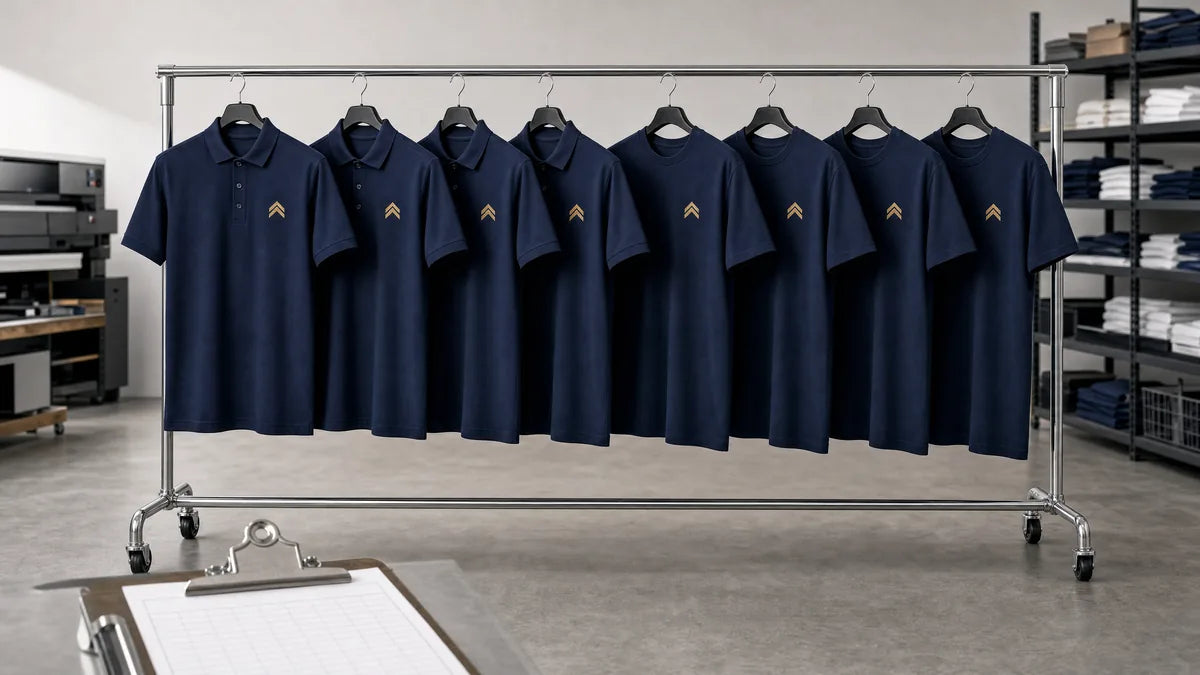
How to run a staff uniform program that stays consistent for years, from garment lock in and dye lots to sizing kits, spec sheets, and decoration files.
Workwear & Uniforms • Program Management
Serving DeLand, Florida; Volusia County; Seminole County; Orange City; Deltona; DeBary; Daytona Beach; Sanford; Lake Mary; and surrounding Central Florida communities and surrounding areas
A staff uniform program is easy to launch and hard to keep matching. The real problem is not month one, it is month fourteen, when a new hire's shirt reads as a slightly different navy than everyone else's on the crew.
Key Takeaways
- Choose a garment with a long production history and record its exact style number, color name, and mill.
- Dye lots shift over time, so buy ahead or replace whole crews at once instead of mixing.
- Sizing guessed from a headcount is the most common failure, so run a fit session first.
- Logo placement must be documented in inches, and the art files belong to both you and your shop.
Why Month One Shirts Stop Matching Month Fourteen Shirts
You have already decided branded apparel is worth it, and it is: consistent uniforms make a small crew look established and trustworthy at a glance. The harder question is how to keep that look consistent as people come and go and shirts wear out. Most consistency problems trace back to a few predictable issues, including discontinued styles, dye lot drift, and decoration that was described in words instead of measurements. Get those under control and your employee uniform program will still look sharp years from now. Ignore them and you end up with a crew that looks like it got dressed from three different closets.
Choosing a Garment That Will Still Exist Next Year
Blank manufacturers discontinue styles and colors with little warning, usually at season change. A program built on a single trendy style is one discontinuation away from a mismatched crew. The safe pattern is to build your branded staff uniforms around a garment with a long production history and a wide color range, then lock in the details so you can reorder for years. Verify before you commit that the style also offers the tall and extended sizes your team will eventually need, because adding a size later that the style never carried is not an option.
Record three things in writing: the exact style number, the manufacturer color name, and the mill. Never rely on a color word alone, because navy is a different color at every brand. This matters at scale too. There are thousands of employers across the region, and according to the Census Bureau's QuickFacts for Volusia County, the local economy runs on the kind of small and mid sized businesses that live or die on repeat customer trust, which a consistent uniform quietly supports.

Keep a reference garment: Ask your shop to hold one physical sample on file so a future run can be laid next to the original and checked by eye, not just by number.
Why Two Navy Shirts Can Look Different
Even the identical style and color number shifts between dye lots. Two shirts from the same brand bought eight months apart can read as clearly different navies under shop lighting, and there is nothing wrong with either one. This is normal manufacturing behavior, not a defect, but it will wreck the look of a crew if you mix freely. You have two honest ways to manage it.
- Buy the full projected year in one purchase where you have the storage to hold stock.
- Accept lot drift and replace whole crews at once, rather than dropping new shirts into a team wearing older ones.
"A uniform program is only as consistent as the records behind it. A color word is a wish. A style number, a color name, and a reference garment are a plan."
Getting Sizing Right Before the First Box Ships
Sizing is the single most common failure in a uniform rollout. A first order guessed from a headcount almost always leaves a business short on 2XL and long on small. Before you commit, run a fit session or order a sizing kit with sample garments in every size that staff actually try on, because unisex and women's cuts fit very differently and a real program offers both instead of forcing one cut on everyone. Guessing here is one of the classic mistakes that derail a first workwear order.
Then keep a roster. Record employee name, size, and issue date so a new hire in month nine gets the right size on day one with no guessing and no reorder delay. That single spreadsheet removes most of the friction that makes uniform programs feel like a hassle to run.
Keep every staff shirt matching, order after order
Tell us your headcount, your size spread, and the garment and thread colors you already use, and we will build a spec sheet we keep on file for every reorder. Send print ready artwork as vector or a high resolution PNG with a transparent background so your logo reproduces the same way every time.
Start a uniform program →Locking Down Decoration So the Logo Never Drifts
Logo placement must be recorded in inches, not described in words. Left chest is not a spec. Three and a half inches wide, centered eight inches down from the high point of the shoulder, is a spec. Decide once whether the print scales up with garment size, then write the decision down, because a logo sized for a small can look lost on a 3XL. This kind of precision is exactly what keeps embroidered polos and left chest logos looking identical across an entire team.
For embroidery, thread colors are numbered, and those numbers belong on the spec sheet along with the saved digitized stitch file so nobody re digitizes the logo and gets a slightly different result. For screen printing, record ink colors as standard numbers with the print width and mesh count. One more rule matters more than any single spec: the artwork is an asset. Vector art and embroidery stitch files should be held by both the shop and your business, so ask how long your shop retains files. If you ever change shops, those files travel with you.

Qwik Tees works from finished, print-ready artwork, so keep a clean vector or high-resolution version of your logo on file. That single file is what protects your brand's consistency for the entire life of the program.
One Brand Across Every Role
Most businesses need more than one garment. Front of house wears polos, field crews wear tees, anyone near traffic needs high visibility, and winter mornings call for outerwear. The trick that ties it all together is simple: keep the logo identical across every piece, same size and same placement, so the whole program reads as one brand even when the garments differ. That consistency is what separates a real staff uniform program from a pile of assorted branded shirts.
High visibility gear carries its own compliance rules that go beyond looking bright. The classes behind hi vis garments come from consensus standards coordinated by the American National Standards Institute, so it is worth treating that category separately. When your program includes roadside or traffic exposure, plan those pieces around hi vis and safety apparel rather than trying to force a standard tee to do the job.

Laundering and Realistic Life Expectancy
A work shirt in daily rotation is a consumable, and how it is washed decides how long it survives. Hot water, high heat drying, and bleach shorten both garment life and decoration life, so issue a short care card with every batch of shirts. For trades that deal with grease, dirt, or chemicals, darker colors and heavier fabrics hide wear far longer and stretch the life of the program between reorders.
Fabric choice also has to respect the Central Florida climate. Outdoor crews in DeLand, Deltona, Sanford, and across the region work through real summer heat, and OSHA's heat illness prevention guidance urges employers to plan for hydration, rest, and shade. Lighter, breathable fabrics for field staff are part of that plan, which is another reason many local businesses run two garments: a heavier shirt for cool mornings and a lighter one for peak summer.
The Spec Sheet Checklist You Can Copy
Write this down once and keep it with your logo files. Any future order, at any shop, can be matched from it. This is the document that turns a good first order into a durable branded staff apparel program.
- Garment brand, exact style number, and mill.
- Manufacturer color name for each color used, plus a physical reference garment on file.
- Sizes carried, including tall and extended sizes, with both unisex and women's cuts noted.
- Employee roster with name, size, and issue date.
- Logo placement in inches, and whether print scales up with garment size.
- Decoration method with thread numbers or ink numbers, print width, and mesh count.
- Saved vector art and digitized stitch file, held by both you and your shop.
- Replacement policy and a small buffer stock in your most common sizes.
Buffer stock wins: Keep a few units in your most common sizes on hand so a new hire is in uniform on day one instead of week three.
What to Send Us for an Accurate Quote
When you are ready to build or rebuild a program, send four things: your print-ready logo file, the garment or style you want, the decoration method and placement, and a size breakdown from your roster. With those in hand, we can help you choose durable options that will still be available for reorders and match your existing shirts as closely as possible. Businesses across Volusia County, Seminole County, and the wider Central Florida area rely on that groundwork to keep crews looking uniform year after year. When you have your details together, reach out to start a uniform program quote and we will help you set it up to stay consistent.
Frequently Asked Questions
How do I keep uniform colors consistent over time?
Record the exact style number, manufacturer color name, and mill on a written spec sheet, and keep a physical reference garment on file. Because dye lots shift, either buy the full projected year at once or replace whole crews together instead of mixing new shirts into old ones.
What information belongs on a uniform spec sheet?
List the garment brand, style number, exact color name, sizes carried, logo placement in inches, decoration method, thread or ink color numbers, and print width. A complete spec sheet lets any future order match the original with no guessing.
Who should pay for uniform replacements?
Two common patterns work well: employer funded uniforms on a fixed rotation, or an employer funded initial issue with employee funded replacements after that. Decide the policy in advance and put it in writing so every hire is treated the same way.
Where can I set up a staff uniform program near DeLand, Florida?
Qwik Tees Printing & Embroidery is based in DeLand and serves businesses across Volusia County, Seminole County, and surrounding Central Florida communities including Orange City, Deltona, DeBary, Daytona Beach, Sanford, and Lake Mary. Send your logo files and headcount to request a quote.
How long do work uniforms last?
A shirt in daily rotation is a consumable, and its life depends on how it is washed. Hot water, high heat drying, and bleach shorten both fabric and decoration life, while darker colors and heavier fabrics hide wear far longer in dirty trades.
Keep every staff shirt matching, order after order
Tell us your headcount, your size spread, and the garment and thread colors you already use, and we will build a spec sheet we keep on file for every reorder. Send print ready artwork as vector or a high resolution PNG with a transparent background so your logo reproduces the same way every time.
Start a uniform programNo commitment required · Free consultation


