
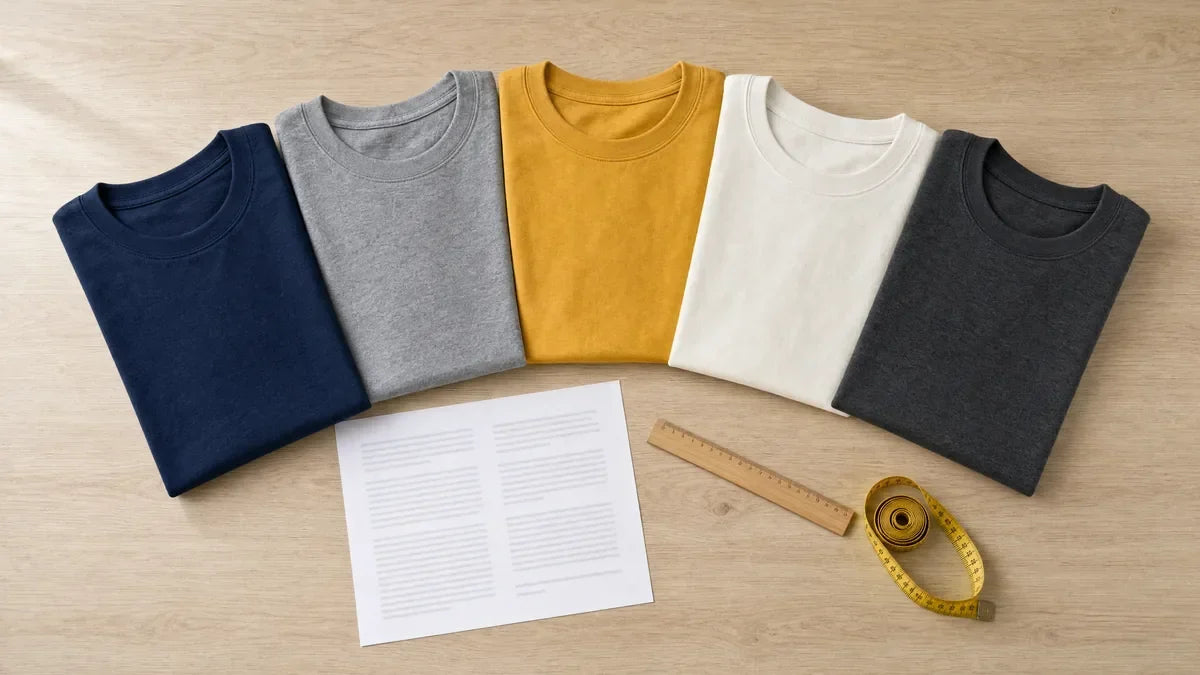
Fabric weight, yarn count, shrinkage, and sizing decide how a blank prints and wears. Here is how to choose blank t-shirts before you place a custom order.
Custom Apparel • Blank Garment Guide
Serving DeLand, Florida; Volusia County; Seminole County; Orange City; Deltona; DeBary; Daytona Beach; Sanford; Lake Mary; and surrounding Central Florida communities.
Someone hands you a style number and asks you to approve it. If you do not know what the numbers on the spec sheet mean, you are guessing. Learning how to choose blank t-shirts before any ink is applied is the single best way to avoid a bad order.
Key Takeaways
- Fabric weight is measured in ounces per square yard, and heavier is not automatically better in Florida heat.
- Finer ring spun yarn prints cleaner than coarse open end yarn.
- Preshrunk means shrinkage was reduced, not eliminated, so size for the shirt after several washes.
- Construction details like shoulder taping and double needle hems predict how long a shirt lasts.
- One washed sample answers more questions than any spec sheet.
Why the Blank Matters Before Any Ink Touches It
Every custom shirt starts as a blank garment, and that blank decides most of the final result. The print method gets the attention, but the fabric controls how the shirt feels, how the design reads, how the shirt fits after washing, and whether people actually wear it. A spec sheet is just a list of measurable facts about that blank. Once you can read those facts, choosing becomes a decision instead of a gamble.
This guide walks through the parts of a spec sheet in plain language. It is written for business owners, coaches, church staff, and event organizers across Central Florida who have been handed a number and need to make a smart call. No brand roundup, just the specifics that matter.
Fabric Weight and What the Ounces Mean
Weight is listed in ounces per square yard. Roughly, 3.5 to 4.3 ounces is lightweight and fashion cut, soft and drapey but more see through in light colors. 4.5 to 5.3 ounces is midweight, the everyday workhorse range. 5.5 to 6.1 ounces and up is heavyweight, opaque and stiff at first, and it is the range most work environments want. Heavier is not automatically better. A heavy shirt in August in DeLand gets left in a drawer.

Match the weight to the job. A landscaping or HVAC crew working outdoors in Volusia County will live in a breathable midweight shirt, while a heavier tee suits indoor uniforms or retail staff. The construction and extraction trades are a large workforce, as shown in the Bureau of Labor Statistics' construction occupation data, and those crews put shirts through real abuse, so weight and durability need to line up with the daily use.
Weight tip: In Central Florida heat, favor a midweight blank for anything worn outdoors all day. Save the heavyweight blanks for uniforms and cooler settings.
If you are still deciding what kind of shirt fits your project, our page on custom printed t-shirts covers the common uses and options so you can narrow the choice before you look at spec sheets.
Yarn Count, Spin, and What Makes a Shirt Feel Right
Spec sheets list singles, often written as 30 singles or 30/1. A higher singles number means a finer yarn, a smoother surface, and a softer hand. 30 singles combed ring spun is the modern retail feel. 18 to 20 singles is coarser, thicker, and holds up better to abrasion. Finer yarn also gives a cleaner print surface, with less fabric texture showing through the ink.

Spin type matters just as much. Open end, sometimes called carded, is spun faster and cheaper. It has more slubs and a rougher face, so fine line art and small text look grainier on it. Ring spun is twisted tighter and reads smoother under both ink and film. Combed means short fibers were removed before spinning, which is why combed ring spun feels the way it does. When a design has thin lines or small type, spin type is not a detail to skip.
Fiber Content and What Each Blend Does
100 percent cotton takes ink cleanly, breathes well, and shrinks the most. A 50/50 cotton poly blend shrinks less, wrinkles less, and sits between the two on softness. Tri blends add rayon for drape and a vintage hand, but rayon moves the most in the wash and the surface is slightly slicker. Polyester heavy blends resist shrinking but can push dye up into the print under heat, which is a real problem in reds and royals. Heather colors are almost always poly blended even when the base style is called cotton.
Fiber content is not just a comfort question, it is a legal labeling question too. Manufacturers disclose fiber percentages under the FTC's textile labeling requirements, so the numbers on a spec sheet reflect what is actually in the garment. Read them before you assume a heather is cotton.
Get the right blank matched to your print
Tell us the style you are looking at, the colors and sizes you need, and how the shirts will actually be worn and washed. Send print ready artwork at full size and we will confirm whether that blank suits the print method before anything goes on press.
Ask About a Blank →Heather and safety colors are usually blended, so the same design can behave differently on a heather shirt than it does on a solid cotton one.
If you want a shortcut on durability and feel, our guide on which blank brands hold up best breaks down how different construction levels perform in real use.
Shrinkage and What Preshrunk Actually Means
Preshrunk means shrinkage was reduced during finishing, not eliminated. Expect residual movement in the wash, and most of it shows up in the body length rather than the chest. Rayon blends move more than cotton. If a group is ordering to a tight fit, size for the shirt after five washes, not the shirt straight out of the poly bag. This is where a lot of group orders go wrong.
"Size for the shirt after five washes, not the shirt out of the poly bag."
How the shirts are laundered changes the outcome, so the care routine is part of the sizing decision. Our article on how to wash custom apparel so it lasts explains the habits that keep shirts closer to their original fit and protect the print at the same time.
Reading the Size Chart and Construction Details
Body length is measured from the high point of the shoulder to the hem. Chest width is measured flat across the shirt one inch below the armhole, so it is a half chest measurement. Double it to compare against a body measurement. A tolerance of about half an inch to an inch is normal and is not a defect. Never size a group from another brand chart, because styles that share a size letter do not share the same measurements.

Construction details predict durability. Watch for these three:
- Shoulder to shoulder taping, which keeps the neck from stretching out.
- Double needle stitching on sleeve and bottom hems, which resists unraveling.
- Collar rib width and spandex content, which tell you whether the neck stays round after months of wear.
Side seamed versus tubular also affects shape. Tubular bodies are knit as a tube with no side seams, so they run boxier and tend to twist after washing. Side seamed bodies hold a tailored shape and stay square, which reads better on staff who will be photographed. And if the shirts are for kids, remember that youth garments carry their own testing and labeling rules under the Consumer Product Safety Improvement Act, and youth and adult versions of the same style are often different garments with different fits.
How the Blank Changes the Print
The blank surface decides how much detail the decoration can hold. Smooth, finer yarn surfaces show fine detail. Coarse open end surfaces swallow thin lines. Poly heavy and heather fabrics need low temperature curing and a blocking approach to stop dye migration. Textured knits, water repellent finishes, and coated shells are poor candidates for anything heat applied.
This is why the blank and the method are chosen together, not separately. A design that looks crisp under screen printing on a smooth cotton tee may look muddy on a rough blend, and a full color transfer needs a surface that can take heat cleanly. Pick the fabric with the print in mind, and half the problems disappear before production starts.
Print tip: Tell your decorator the exact style number and color before finalizing, so the fabric surface and the print method are matched from the start.
The One Sample Test
There is one test that beats every spec sheet. Order one shirt in the exact style and color. Wash it five times the way the group will actually wash it. Measure the body length before and after. Wear it once. That single sample answers more questions about fit, shrinkage, feel, and durability than any list of numbers can.
If you are unsure which blank fits your project, send us the style number you are looking at and we can review the spec sheet with you before anything is ordered. We work with customers across DeLand, Deltona, Orange City, DeBary, Sanford, Lake Mary, Daytona Beach, and the wider Central Florida area on both small and bulk orders.
Common Mistakes to Avoid When You Choose Blank T-Shirts
- Choosing by weight alone and ignoring yarn, fiber, and construction.
- Assuming preshrunk means the shirt will not shrink at all.
- Sizing a group off a chart from a different brand.
- Picking a heather color and expecting the print to behave like it does on solid cotton.
- Ordering half the group now and half later when color match matters, since dye lots vary between runs.
Read the spec sheet, match the blank to the job and the print, wash a sample, and order the whole group at once when color consistency counts. Do that, and you will choose blank t-shirts with confidence instead of hoping the box shows up right. When you are ready, the team at Qwik Tees Printing & Embroidery in DeLand is here to help you get it right the first time.
Frequently Asked Questions
Does fabric weight tell me everything about quality?
No. Weight only measures ounces per square yard. Yarn fineness, fiber content, and construction details like shoulder taping and double needle hems matter just as much for how a shirt wears and prints.
What does preshrunk actually mean on a blank t-shirt?
Preshrunk means shrinkage was reduced during finishing, not eliminated. Expect some residual movement in the wash, mostly in the body length. Rayon blends move more than cotton, so size for the shirt after several washes.
Can I mix sizes from two different brands in one group order?
It is risky. Styles that share a size letter do not share measurements. Always size a group from the exact chart for the exact style you are ordering, and never assume a medium in one brand matches a medium in another.
Where can I get help choosing blank t-shirts near DeLand and Volusia County?
Qwik Tees Printing & Embroidery in DeLand helps customers across Volusia County, Seminole County, and surrounding Central Florida communities pick the right blank based on fabric, quantity, budget, and intended use. Send us the style number you are considering and we can walk through the spec sheet with you.
Why does my print look grainier on some blank shirts than others?
The blank surface controls how much detail shows. Finer ring spun yarn gives a smooth print surface, while coarse open end fabric swallows thin lines and small text. Heather and polyester heavy fabrics can also push dye into the print under heat.
Get the right blank matched to your print
Tell us the style you are looking at, the colors and sizes you need, and how the shirts will actually be worn and washed. Send print ready artwork at full size and we will confirm whether that blank suits the print method before anything goes on press.
Ask About a BlankNo commitment required · Free consultation


